
It is the most important vehicle used for land interventions in firefighting operations. Water storage capacity varies. Recommendations and determinations regarding the use of “3-F” in water tenders;
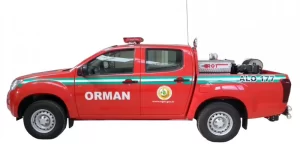
These vehicles have easier and faster movement capabilities compared to large tonnage vehicles. It provides a great advantage for early intervention against fire. It usually has a water capacity of 300 lt. By adding enough “3-F” extinguishing and cooling product, the extinguishing and cooling performance of at least a 3-ton water truck is achieved. For effective extinguishing and cooling, 2 canisters (2×20 lt.) of product mixture is recommended for each IMA tank.

It is especially preferred in rural areas and villages. It is generally produced with a capacity of 3 tons. In fires that occur in villages and hamlets that are far from settlement centers, there are more casualties. In order to intervene early and effectively in fires that occur in rural areas and especially in forest villages, by providing “3-F” product to each forest village and making the necessary distribution to the mukhtars, great success is achieved in fire fighting operations of forest villages. Adding 300 kg of “3-F” to a 3-ton fire tanker gives an efficiency equivalent to the extinguishing operation performed with 30 tons of water (approximately).
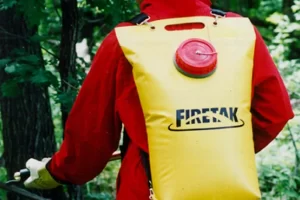
In fire extinguishing operations, portable back pumps are preferred for small, point fires that cannot be reached by air and land vehicles, but have the capacity to grow under adverse weather conditions. When “3-F” is added to a 15-25 lt. capacity back pump, the equivalent result is obtained by extinguishing with 150-250 lt. of water. Since there is limited water and product use in this method, the product concentrate can be increased. In these applications, it is recommended to use 1/3 of the product. In firefighting operations performed by adding “3-F” extinguishing and cooling product, the ambient temperature drops below 60 C 30 seconds after the application with the back pump, cooling continues rapidly and no further flare-up occurs. There is no need for a cooling process.






 A minimum of 3% is recommended in applications where a fire pool is used as a water source.
Before the fire season, sufficient quantities of “3-F” product can be stocked in polyethylene tanks in fire-sensitive areas.
A minimum of 3% is recommended in applications where a fire pool is used as a water source.
Before the fire season, sufficient quantities of “3-F” product can be stocked in polyethylene tanks in fire-sensitive areas. 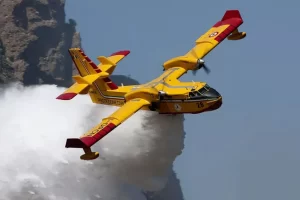 Some of the aircraft used in firefighting operations can fill from natural water sources (sea, lake, pond etc.). Others can fill from depots or supply vehicles located at airports. Aircraft operating in this second section generally drop water or retardant products (in order to reduce the spread of fire). There is no need for a separate process for the water added with ‘‘3-F’’ from these aircraft. The application procedure for other products is the same for ‘‘3-F’’.Extinguishing and cooling operations performed using the “3-F” product provide definitive results in a very short time.