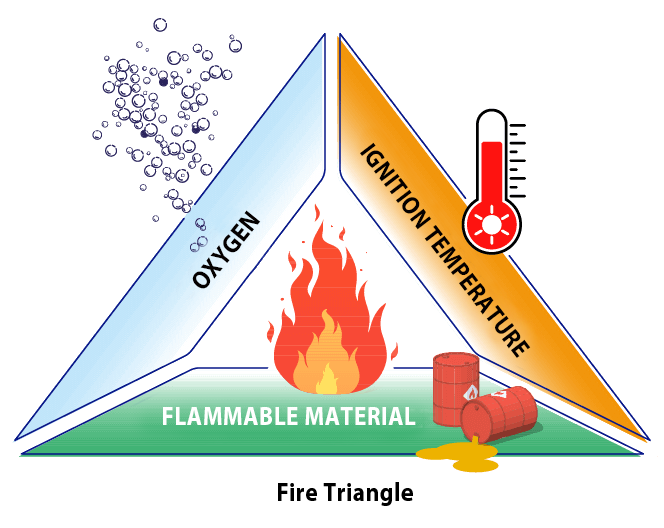
COMBUSTION-FIRE: The exothermic chemical chain reaction that occurs when solid, liquid and gaseous substances reach the ignition temperature with the help of heat and oxygen is called combustion, and the uncontrolled development and growth of the chain reaction that occurs in the combustion event is called fire.
CONDITIONS OF BURNING: Three main factors are necessary for combustion to occur;
1 – Flammable Materials: Substances that burn when heated to the point of combustion or flame, combine with oxygen, and emit heat to their surroundings when burned are called flammable substances.
They are found in three forms in nature;
1-Solid: Wood, Coal, Textiles, Plastic, Paper, Rubber, Leather, etc.
2-Liquid: Gasoline, Diesel, Fuel-Oil, Paint, Oils, Alcohol, etc.
3-Gas: Methane, Ethane, Propane, Butane, Hydrogen, etc.
2 – Oxygen:
It is non-flammable but when combined with flammable materials at a certain rate (accompanied by a certain heat), it has a burning effect.
It is found at a rate of 21% in the atmosphere. In order for combustion to continue, there must be 12% and above oxygen in the environment for gas fires and 16% and above for solid and liquid fires.
3 – Heat:
It is the most important factor required for combustion to occur. Because in daily life, there is constant contact between flammable material and oxygen. However, the factor that will start combustion is heat.
In order for combustion to start, the temperature must reach the combustion or ignition temperature of the flammable materials. This value is different for each substance.
NAME OF THE MATTER
IGNITION TEMPERATURE
Cotton
400º C
Cotton Fabric (Raw Cloth)
225º C
Cotton Fabric (Finished)
275º C
Wool
600º C
Nylon 6.66
425º C (melts between 160 º C – 260 º C)
Polyester
450–485ºC (It softens at 256 º C -292 º C and flows drop by drop)